Kashi: The City Older Than Time Itself
Varanasi — called Kashi in the scriptures, Banaras by its residents, and the city of light by those who have felt its inexplicable grace — is the oldest continuously inhabited urban settlement on earth. While civilisations rise and fall, empires appear and vanish, and rivers change their courses, Kashi endures. It has been a living city for at least three thousand years, possibly longer, and every single day of those three thousand years has begun with the sound of conch shells on the Ganga ghats.
The Skanda Purana dedicates an entire section called Kashi Khanda to this city, declaring that Kashi is the personal abode of Shiva — not a place he visits, but a place he inhabits permanently and refuses to leave. When the great dissolution (pralaya) comes and the universe is unmade, Shiva is said to hold Kashi on the tip of his trident to preserve it, and recreate the world from this single point. This is not mythology for Varanasi's residents; it is the lived reality that gives meaning to every morning.
Mark Twain, who visited in the 1890s, wrote: 'Benares is older than history, older than tradition, older even than legend, and looks twice as old as all of them put together.' Twain was responding to something real — a quality of permanence, of density, of accumulated human meaning that makes Varanasi feel like a living scripture rather than a city.
The Promise of Moksha: Why Dying in Kashi Is a Blessing
Kashi is one of the five places in Hindu tradition where dying is considered a doorway to liberation rather than an end. The scripture known as the Kashi Rahasya states that Shiva himself whispers the Taraka mantra — the Ram naam — into the ear of every person who departs from Kashi, and this final divine utterance dissolves all karma and grants moksha regardless of the person's past actions. This is why for two thousand years, devout Hindus from across India have come to Varanasi in their final years to spend their last days on the banks of the Ganga.
Manikarnika Ghat — the primary cremation ghat of Varanasi — has not seen its funeral pyres extinguished for over two thousand years. Day and night, without pause for monsoon or festival or war, bodies are brought here, wrapped in silk and marigolds, and returned to the five elements. The smoke that rises from Manikarnika is not a grim sight for those who understand its meaning; it is the visible evidence of liberation in progress. The Dom Raja family, who have tended the eternal flame here for generations, are one of the most spiritually significant families in Hinduism.
For pilgrims who visit Varanasi, the correct attitude is not one of tourism but of preparation. The city invites you to confront the reality of impermanence — not as a philosophical exercise, but as a visceral, lived experience. Many who come to Varanasi 'just to see' leave transformed in ways they did not anticipate and cannot fully explain.
Kashi Vishwanath: Shiva's Personal Temple
The Kashi Vishwanath temple houses one of the twelve Jyotirlingas — the twelve self-manifested forms of Shiva that appeared as columns of infinite light when Brahma and Vishnu disputed supremacy. Of these twelve, Vishwanath in Kashi is considered the most potent, because it is the one Jyotirlinga that Shiva chose as his permanent personal residence. The Sanskrit name Vishwanath means 'Lord of the Universe' — not a title but a description.
The temple complex, significantly expanded and redeveloped as the Kashi Vishwanath Corridor inaugurated in 2021, now allows pilgrims to see the Jyotirlinga while simultaneously having a view of the Ganga — something that was not architecturally possible in the previous structure. The Jyotirlinga itself is a naturally occurring black stone lingam set in silver, and the energy in the sanctum during the morning and evening aartis is described by pilgrims as an almost physical force.
Five aartis are performed daily at the Kashi Vishwanath temple — the Mangla Aarti before dawn, the Bhog Aarti in the late morning, the Sandhya Aarti at sunset, the Shringaar Aarti in the evening, and the Shayan Aarti just before midnight when Shiva is ceremonially put to rest. Of these, the Mangla Aarti at approximately 3 AM is the most sought-after, carrying a sense of intimate devotion that the busier daytime aartis cannot replicate.
✦Practical Tips
- ›Darshan queues at Kashi Vishwanath can exceed four hours during peak seasons. Book the 'VIP darshan' slot online through the temple trust for a dedicated time window.
- ›The Mangla Aarti requires advance registration and has limited capacity. Book at least a week in advance.
- ›The garbhagriha (inner sanctum) dress code is strict — only traditional Indian wear. No shorts, sleeveless, or Western formal wear.
- ›A local priest-guide (pujari) is invaluable for navigating the rituals correctly and understanding the significance of each gesture.
The 84 Ghats: A Complete Sacred Landscape
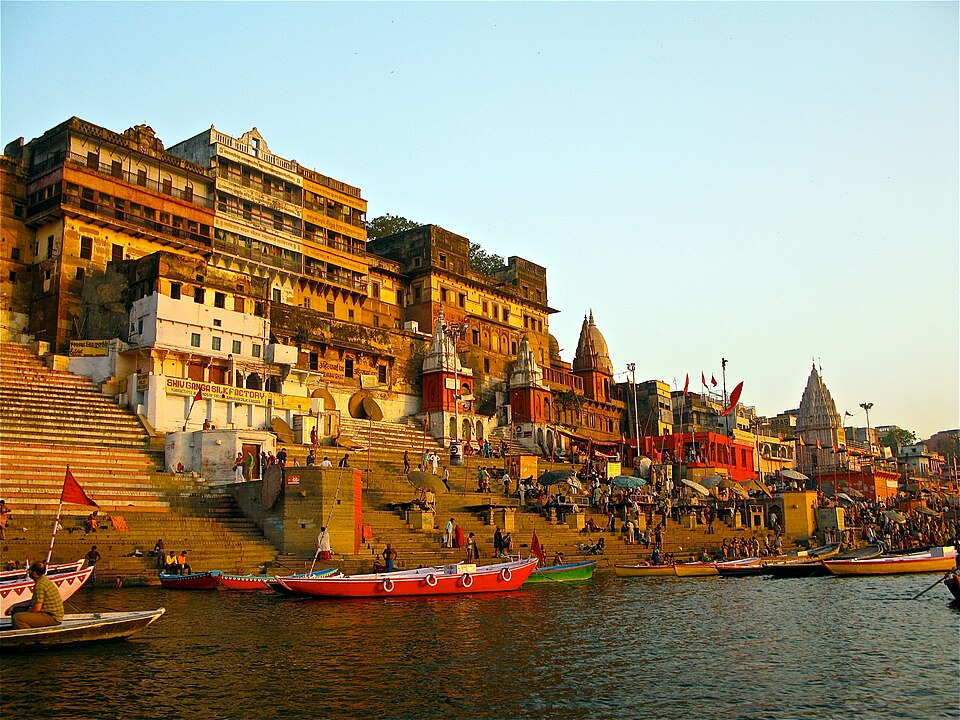
Varanasi's 84 ghats — stone-stepped riverbanks extending along a crescent-shaped arc of the Ganga — are among the most remarkable human constructions in the world, not for their engineering but for their purpose. Each ghat has its own character, its own deity, its own ritual significance, and its own resident community of priests, boatmen, sadhus, and pilgrims. Together, they constitute a complete spiritual ecosystem that begins at Assi Ghat in the south and ends at Raj Ghat in the north.
Dashashwamedh Ghat is the spiritual centre of Varanasi's ghat life. Its name refers to the ten horse sacrifices (Dasha-Ashwamedha) that Brahma performed here at the beginning of creation, and it is here that the famous Ganga Aarti is performed every evening with a precision, scale, and devotional intensity that has made it one of the most spiritually powerful public ceremonies in the world. Seven young priests stand on individual platforms, each holding a multi-tiered brass lamp stand, and perform the aarti in perfect synchrony as night falls over the Ganga.
Assi Ghat — at the southern end — is where the Assi and Ganga rivers meet, and is the ghat where the Subah-e-Banaras (Morning of Banaras) ceremony is held every day at sunrise. A small but profoundly moving aarti performed by a single priest at the Shivalinga on the ghat, followed by the soft sounds of a shehnai played live, makes this one of the most meditative morning experiences in India. Panchaganga Ghat, where five sacred rivers are believed to meet invisibly, and Manikarnika Ghat, the cremation site, are other ghats of deep spiritual significance.
The Ganga Aarti: Witnessing the Divine at Dashashwamedh
The Ganga Aarti at Dashashwamedh Ghat begins at dusk — the precise time varies with the season — and is performed daily without exception, including during monsoon floods, cold winter fog, and festival chaos. Seven priests of the Ganga Sewa Nidhi, trained from childhood in the specific ritualistic style of this aarti, stand on individual raised platforms facing the river and perform a sequence of ritual gestures with large brass lamps.
The ceremony lasts approximately 45 minutes and includes conch-blowing, incense, flower offerings, and the waving of the lamps in specific patterns corresponding to the hymns being chanted. As the ceremony builds to its climax, the sound of the bells, the shimmer of the lamps reflected on the Ganga, and the clouds of incense create a multi-sensory experience that removes the boundary between the ritual and the witness. Many pilgrims report feeling a sudden and inexplicable peace during the aarti — a stillness that comes without seeking it.
For the optimal aarti experience, arrive at Dashashwamedh Ghat at least forty-five minutes early to secure a position on the ghat steps directly facing the river. Alternatively, hire a boat — the view of the aarti from the middle of the Ganga, with the entire ghat illuminated and the smoke rising, is one of the most transcendently beautiful visual experiences in all of India.
Sarnath: Where the Buddha First Turned the Wheel
Ten kilometres from Varanasi's old city, accessible by auto-rickshaw in 30 minutes, lies Sarnath — one of the four holiest sites in Buddhism. It was here, in the Deer Park (Mrigadava), that Siddhartha Gautama delivered his first sermon after attaining enlightenment in Bodh Gaya, setting in motion the 'Dharma Chakra' that would become one of the world's major spiritual traditions. The Dhammek Stupa at Sarnath, a massive cylindrical structure rising 28 metres, marks the precise spot where the Buddha taught.
For Hindu pilgrims visiting Varanasi, Sarnath offers a meaningful complementary experience. The Varanasi-Sarnath corridor represents the confluence of two of the world's oldest living spiritual traditions — Shaivism and Buddhism — both rooted in the same geographical soil. The Archaeological Museum at Sarnath houses the original Ashoka capital with four lions back-to-back — the emblem that now appears on India's national seal — and the famous Dharmachakra frieze.
Best Time to Visit & How to Reach
October through March offers the most comfortable climate for exploring Varanasi's ghats and temple circuit. The Ganga in winter carries a particular clarity and the morning mist creates an atmospheric backdrop that is almost impossible to photograph adequately — it must be experienced in person. Dev Deepawali, celebrated on Kartik Purnima (October-November), is Varanasi's most spectacular festival: every single ghat is lined with lakhs of diyas and the Ganga becomes a river of light.
Varanasi's summers (April-June) are extremely hot and humid, making the long ghat walks uncomfortable. The monsoon season (July-September) brings heavy rains that often flood the lower ghats, but the city's energy during monsoon — the green fields surrounding the city, the swollen Ganga, and the relative quiet of the temples — has its own contemplative beauty.
Varanasi is well-connected by all three modes of transport. Lal Bahadur Shastri International Airport receives flights from major Indian cities and selected international routes. Varanasi Junction (Kashi Station) is a major railway hub. Road connectivity via NH19 and NH31 connects Varanasi to Prayagraj (120 km), Ayodhya (200 km), Lucknow (300 km), and Delhi (820 km).
✦Practical Tips
- ›Take a dawn boat ride on the Ganga — book the night before for a 5 AM departure. The sight of the ghats waking up as the sun rises is the defining image of Varanasi.
- ›Hire a local guide for the ghat walk — they will take you into the lanes behind the ghats (the Vishwanath Gali) where the real Banaras lives.
- ›The narrow lanes (galis) of the old city are not navigable by vehicle. Wear comfortable shoes and plan for at least four hours of walking.
- ›For senior pilgrims, the boat option provides access to every ghat without the physical strain of stone steps.