Mahishmati: From Mythological Kingdom to Sacred City
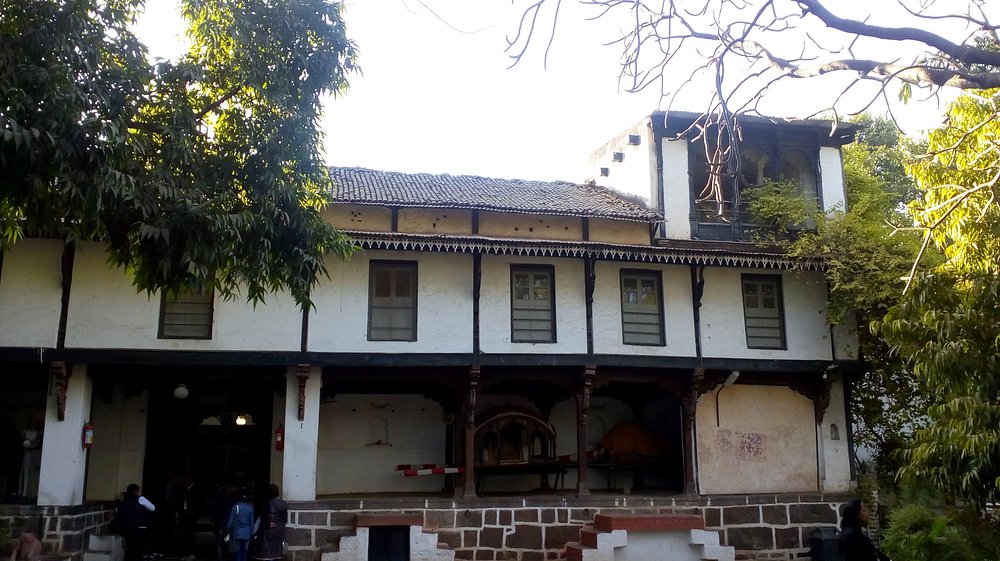
Maheshwar stands on a plateau above the Narmada river in Madhya Pradesh, and before it was called Maheshwar, it was called Mahishmati — the mythological capital of the Haihaya kingdom ruled by King Sahasrarjun (Kartavirya Arjuna), whose thousand arms made him the most powerful monarch of the Treta Yuga. The Mahabharata, Ramayana, and the Puranas all mention Mahishmati as a city of extraordinary power and beauty, with palaces that rivalled the gods'.
The name Maheshwar comes from Maheshwara — another name for Shiva — and the city's deepest identity is Shaiva. The Ahileshwar Mahadev temple on the riverbank, built during Ahilya Bai's reign, enshrines the form of Shiva as the lord of the city, and the Narmada herself — considered in Hindu tradition to be the sister of the Ganga and a goddess in her own right — flows below the fort with a particular clarity and blue-green luminosity that distinguishes the upper Narmada from most Indian rivers.
What most visitors feel within hours of arriving in Maheshwar is a quality of composed peace — something between the energy of Varanasi (which is intense) and the solitude of a forest ashram. Maheshwar is a city that works slowly, that rewards patience, and that reveals itself most fully to those who stay long enough to see it in both morning mist and evening lamplight.
Ahilya Bai Holkar: The Queen Who Restored Sacred India
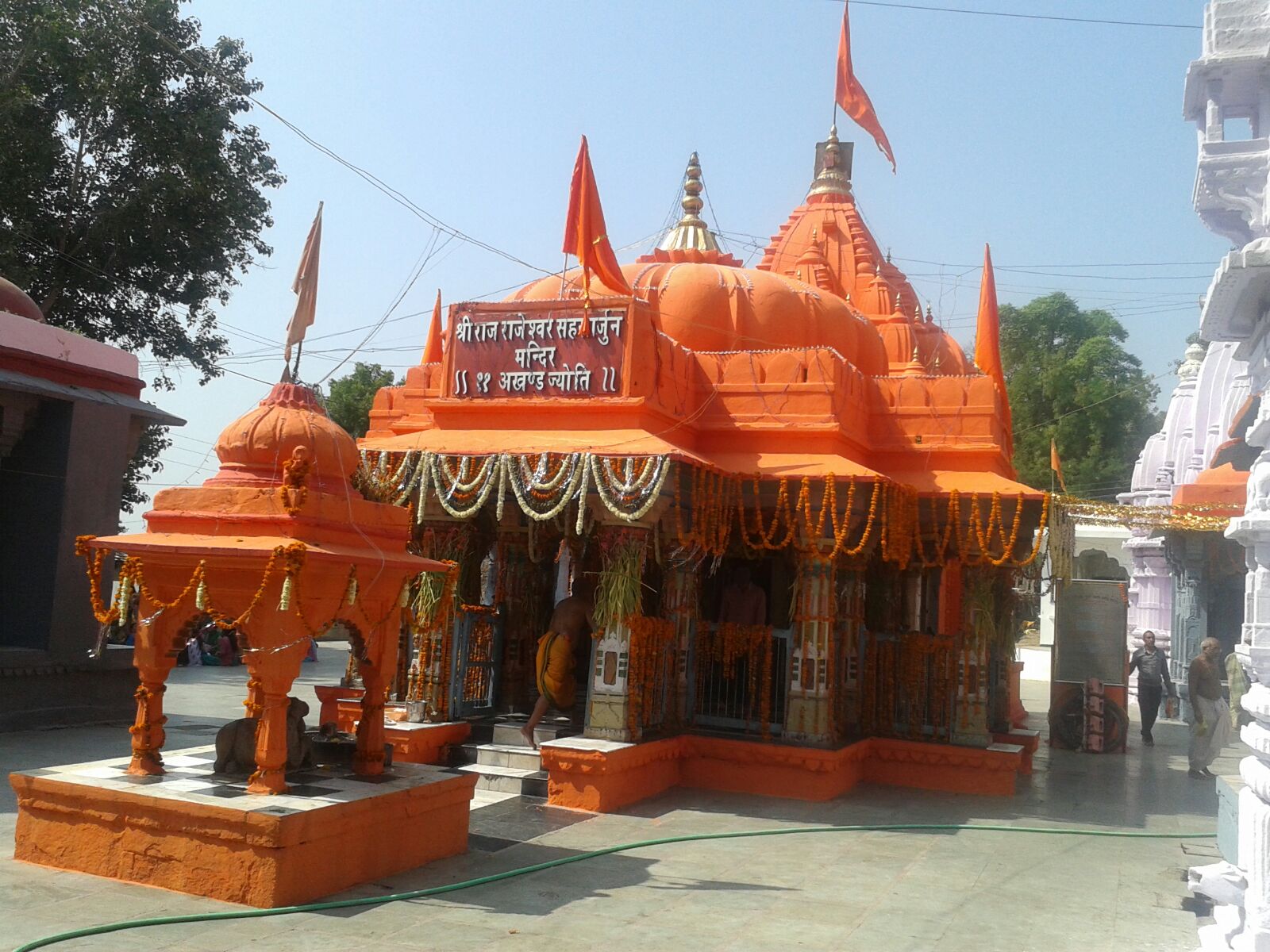
No single figure in the history of Indian sacred architecture and pilgrimage has done more to preserve and restore Hindu religious life than Ahilya Bai Holkar, who ruled Maheshwar from 1765 to 1795 as the queen of the Holkar dynasty. A widow who took full control of her kingdom's administration at age 30, Ahilya Bai governed with such wisdom, justice, and spiritual depth that she is remembered across India not as a political ruler but as a saint-queen — perhaps the only ruler in Indian history to be universally called 'the holy mother.'
In her three decades of rule, Ahilya Bai restored or rebuilt temples at Varanasi, Prayagraj, Haridwar, Mathura, Vrindavan, Dwarka, Nashik, Somnath, Kedarnath, and dozens of other sites that had been damaged or destroyed during the preceding centuries of political instability. She built temples, dharmashalas, ghats, water tanks, and rest houses at hundreds of pilgrimage sites across the subcontinent — not from ego but from a profound sense of duty to the divine and to the pilgrims who sought the divine.
Her personal life was marked by extraordinary devotion and simplicity. She slept on a hard floor, ate the most basic food, gave audiences to all citizens without distinction of caste or wealth, administered justice with legendary impartiality, and corresponded with philosophers, saints, and scholars across India. Her samadhi (memorial) within the Maheshwar fort is one of the most quietly powerful sacred spaces in the city — a small, unadorned room where the queen's sandals are worshipped as a symbol of righteous governance.
Sacred Glimpses

Maheshwar fort palace
The Maheshwar Fort & the Narmada Ghats
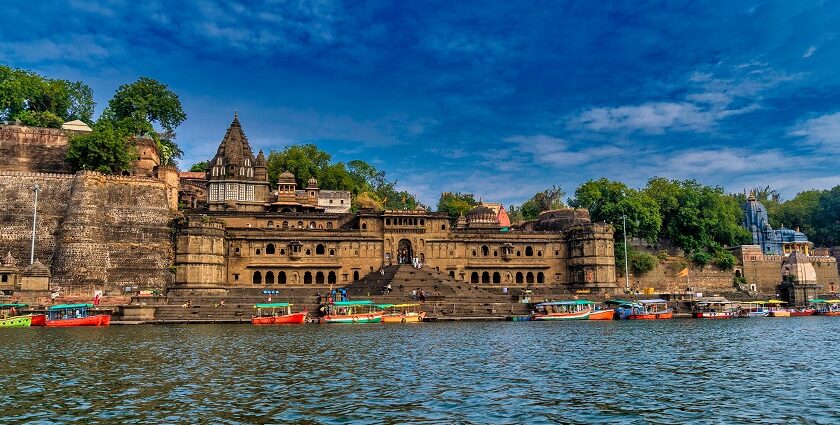
The Maheshwar fort, built and expanded under Ahilya Bai's patronage, sits directly above the Narmada on a sandstone plateau and has the most beautiful riverside position of any fort in central India. Within its walls are multiple temples — the Rajrajeshwar temple, the Ahileshwar Mahadev temple, the Vithal-Rukmini temple, and several smaller shrines — all maintained in excellent condition by the Holkar family trust. The fort also houses a small museum dedicated to Ahilya Bai's life and the Holkar dynasty's history.
Below the fort, the Narmada ghats — particularly the Sahashradhara Ghat, where the river spreads over a wide, rocky riverbed creating a thousand (sahasra) streams — are the site of the daily Narmada Aarti. The aarti, performed at dusk by priests on the ghat steps, is a smaller and more intimate ceremony than the grand spectacles of Varanasi or Ujjain, but its setting — the fort walls rising on one side, the wide river glowing in the last light on the other — gives it a visual and atmospheric quality that is uniquely its own.
Boating on the Narmada from the Maheshwar ghats is one of the most peaceful activities available to pilgrims in all of Madhya Pradesh. The upper Narmada here is calm, clear, and flanked by forested banks. Early morning and evening boat rides allow a view of the fort and ghats from the water that is genuinely serene — the kind of quiet that settles something in the chest that ordinary life keeps rattling.
Maheshwari Sarees: The Living Craft of Ahilya Bai's Court
Maheshwar is famous across India for its Maheshwari sarees — handloom silk-cotton sarees woven in specific traditional patterns that have been produced here for over 200 years. Queen Ahilya Bai herself invited master weavers from Surat and Malwa to establish the craft in Maheshwar, and the sarees were originally made as gifts for courtiers and offerings to the deities in her temples.
The Maheshwari saree is distinguished by its unique border designs (often gold or silver zari), its specific weave patterns (the most traditional being the chevron or zigzag pattern called Ikat), and the particular silk-cotton blend that gives it a combination of the sheen of silk and the durability of cotton. They are sold through the weavers' cooperative and several shops in and around the fort complex at prices that range from a few hundred to several thousand rupees.
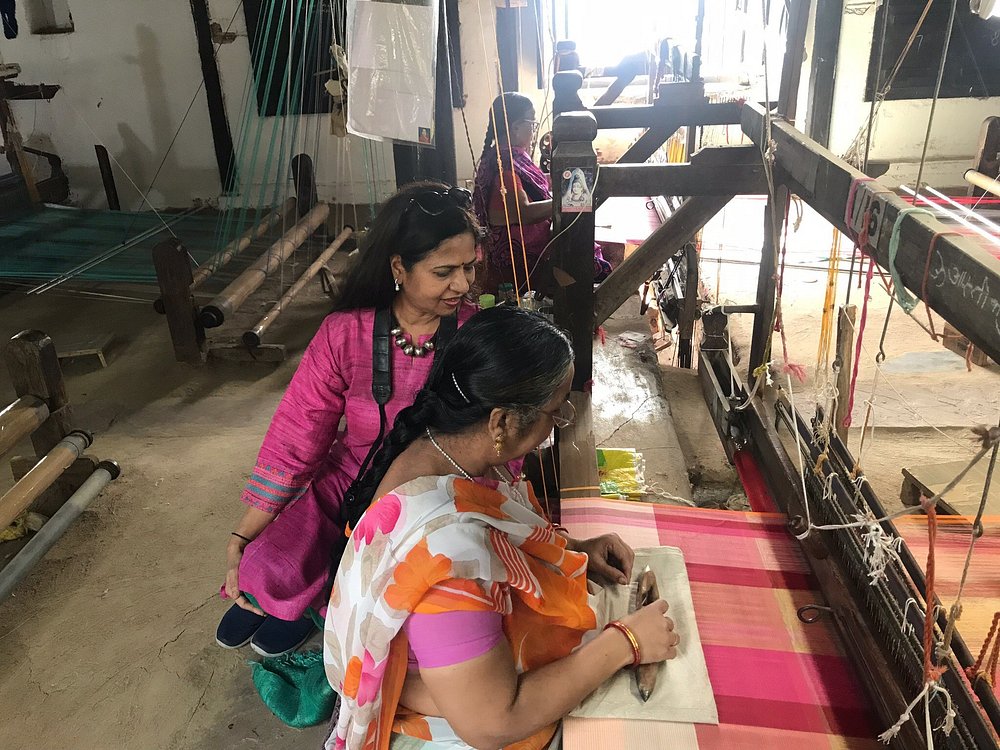
A visit to one of the active weaving centres within the fort — where you can watch the weavers at their handlooms and understand the intricacy of the craft — is one of the most distinctive non-temple experiences Maheshwar offers. For many visitors, purchasing a Maheshwari saree in Maheshwar is both a material acquisition and a spiritual act — a way of carrying something of this city's devotional craft tradition back into ordinary life.
Best Time to Visit & Combining with Omkareshwar
October through March is ideal for Maheshwar. The Navratri festival (twice yearly) brings particular devotion to the fort temples, and Mahashivratri sees a major celebration at the Ahileshwar Mahadev temple. Summers are hot but the fort's stone walls retain coolness, and the Narmada's level drops to reveal more of the rocky riverbed at the Sahashradhara Ghat.
Maheshwar and Omkareshwar (60 km apart, approximately 1.5 hours by road) are naturally combined in a single two-day pilgrimage. Most visitors to this region base themselves in Indore (90 km from Maheshwar, 77 km from Omkareshwar) or in Maheshwar itself. The Fort Heritage Hotel — converted from Ahilya Bai's own palace — is one of the most atmospheric heritage stays in India and allows guests to sleep within the fort walls overlooking the Narmada.
✦Practical Tips
- ›Visit the fort early morning before 9 AM — the light on the sandstone and the quiet of that hour make for the most photogenic and meditative experience.
- ›The Narmada Aarti at dusk is best viewed from the ghat level rather than from above — arrive 30 minutes early for a front position.
- ›The weaving cooperative within the fort (Rehwa Society) is the most authentic place to purchase Maheshwari sarees and supports the artisan families directly.
- ›Allow at least one full day in Maheshwar — it is the kind of place that reveals itself slowly and rewards patience.